Fluid Mechanics
📄 View PDF with notes pagesTOP 15Mark-cutters: slips that cost the most marks
- Darcy or Fanning. $f = 4f'$. "Friction factor" is Darcy ($64/Re$); "coefficient of friction" is Fanning ($16/Re$). Wrong one: answer out by 4.
- Gauge or absolute. Read which one is asked. A vacuum is a negative gauge pressure; absolute pressure is never negative.
- Poise and Pa·s. 1 P = 0.1 Pa·s, 1 cP = 1 mPa·s (water ≈ 1 cP). Treating poise as Pa·s puts the answer out by 10.
- Both sides of a plate. A plate towed through a fluid has a boundary layer on each face: double the one-side drag.
- Relative velocity on a moving vane. Force uses $(V - u)$; for a single plate the mass flow striking it is also $\rho a (V - u)$.
- $D^4$ or $D^5$. At a fixed flow rate, halving the diameter raises the head loss 16 times in laminar flow and about 32 times in turbulent flow.
- Hydraulic diameter. Non-circular duct: $D_h = 4A/P$. Square of side $a$: $D_h = a$; annulus: $D_h = D - d$.
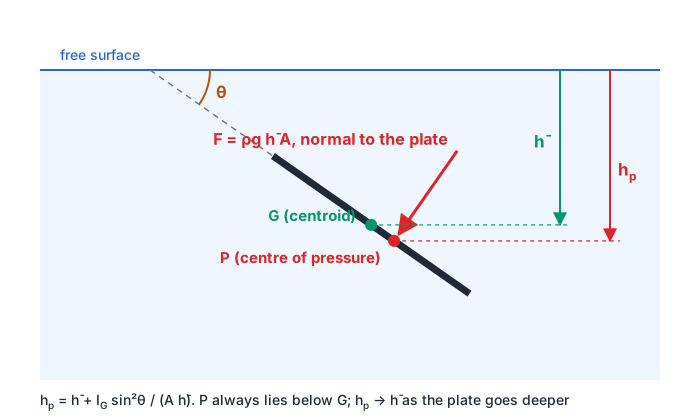
- Centre of pressure on an incline. $h_p = \bar h + \dfrac{I_G\sin^2\theta}{A\bar h}$ is a vertical depth; along the plate it is $\bar y + \dfrac{I_G}{A\bar y}$. Do not mix the two.
- Kelvin in compressible flow. $c = \sqrt{\gamma R T}$ with $T$ in K and $R = 287$ J/kg·K for air.
- Mercury manometer with a liquid in the pipe. $h = x(S_m/S - 1)$, not $x\,S_m/S$; the $-1$ becomes negligible only when the pipe carries a gas ($\Delta P \approx \rho_m g x$).
- Laminar drag grows as $\sqrt{L}$. Doubling a plate's length raises laminar skin-friction drag by $\sqrt2$, not 2; $\delta$ doubles only at four times the distance.
- Paraboloid rules need no spill. "Falls $H/2$ at the axis, rises $H/2$ at the wall" holds only if no liquid spills and the surface does not reach the bottom.
- Bernoulli across streamlines. Only in irrotational flow (free vortex: yes; forced vortex: no).
- Model laws are exclusive. With the same fluid you cannot satisfy Froude and Reynolds similarity together; pick the force that dominates.
- GATE marking. A wrong MCQ costs $\tfrac13$ or $\tfrac23$; MSQ and NAT carry no negative marks, but MSQ gives no partial credit. A NAT answer must fall inside the key's range, so carry enough decimals.
CH 01Fluid and its properties
- Newton's law of viscosity: $\tau = \mu \dfrac{du}{dy}$. Unit of $\mu$: Pa·s = N·s/m² = kg/(m·s). 1 poise = 0.1 Pa·s.
- Kinematic viscosity: $\nu = \mu/\rho$, m²/s. 1 stoke = 1 cm²/s = $10^{-4}$ m²/s. Water at 20 °C: $\nu \approx 10^{-6}$ m²/s; air at 20 °C: $\nu \approx 1.5\times10^{-5}$ m²/s.
- Power-law (non-Newtonian) fluid: $\tau = \tau_0 + k\left(\dfrac{du}{dy}\right)^n$; apparent viscosity $\eta = k\left(\dfrac{du}{dy}\right)^{n-1}$.
| Fluid | Parameters | Behaviour | Examples examiners use |
|---|---|---|---|
| Pseudoplastic | $\tau_0 = 0,\ n < 1$ | Shear thinning: $\eta$ falls as $du/dy$ rises | Blood, milk, paper pulp, paint, polymer solutions |
| Dilatant | $\tau_0 = 0,\ n > 1$ | Shear thickening: $\eta$ rises with $du/dy$ | Starch suspension, quicksand, concentrated sugar solution (butter in Indian texts) |
| Bingham plastic | $\tau_0 > 0,\ n = 1$ | Needs a yield stress before it flows | Toothpaste, drilling mud, sewage sludge |
| Thixotropic / rheopectic | Time-dependent | Thixotropic: $\eta$ falls with time of shearing. Rheopectic: $\eta$ rises | Printer ink, enamels / gypsum slurry |
- Bulk modulus: $K = -V\dfrac{dP}{dV} = \rho\dfrac{dP}{d\rho}$; compressibility $\beta = 1/K$. Ideal gas: isothermal $K = P$, adiabatic $K = \gamma P$.
- Surface tension (N/m): excess pressure in a droplet $\Delta P = 4\sigma/d$; soap bubble (two surfaces) $8\sigma/d$; liquid jet $2\sigma/d$. An air bubble inside a liquid has only one surface, so it is $4\sigma/d$ like a droplet, not $8\sigma/d$.
- Capillary rise: $h = \dfrac{4\sigma\cos\theta}{\rho g d}$. Water–glass $\theta \approx 0°$ (rise); mercury–glass $\theta \approx 130°$ (depression). Fallback · Force balance: surface tension around the rim $\sigma\,\pi d\cos\theta$ = weight of the raised column $\rho g\,\tfrac{\pi d^2}{4}\,h$ → $h = \dfrac{4\sigma\cos\theta}{\rho g d}$
- Vapour pressure and cavitation: $p_v$ is the pressure at which the liquid boils at its temperature. Where the local pressure falls to $p_v$, vapour bubbles form and then collapse violently in higher-pressure zones: cavitation (pump inlets, turbine runners, propellers, siphon summits). Cavitation number $\sigma = \dfrac{p - p_v}{\tfrac12\rho V^2}$: $\sigma = 0$ means the local pressure has fallen to $p_v$, so the liquid boils and cavitation begins; a larger $\sigma$ is safer.
Trap: with rising temperature a liquid's $\mu$ falls (cohesion weakens) but a gas's $\mu$ rises (molecular momentum exchange), roughly $\mu \propto T^{0.5}$.
Trap: water is more viscous than air ($\mu$), yet air has about 15 times the kinematic viscosity, because water is about 800 times denser.
Shortcut, journal bearing (shaft diameter $D$, length $L$, clearance $c$, speed $N$ rpm): $u = \dfrac{\pi D N}{60}$, torque $T = \dfrac{\mu\pi^2 D^3 L N}{120\,c}$, power lost $P = \dfrac{2\pi N T}{60} = \dfrac{\mu\pi^3 D^3 L N^2}{3600\,c}$. Valid when: a thin film, $c \ll D$, so the velocity across the gap is linear Fallback · Viscous power chain: $\tau = \mu u/c$ with $u = \pi D N/60$ → $F = \tau\,\pi D L$ → $T = F\,D/2$ → $P = 2\pi N T/60$
Trap: for a plate sliding on a thin oil film, take a linear profile, $\tau = \mu U/h$, and the force is $\tau \times$ the wetted area; on an incline, the weight component along the slope ($mg\sin\theta$) balances it at terminal speed; sliding down a vertical wall, the whole weight $mg$ does, so $V = \dfrac{mg\,h}{\mu A}$.
Capillary between two parallel plates (gap $t$): $h = \dfrac{2\sigma\cos\theta}{\rho g t}$, half the rise in a tube of diameter $t$.
CH 02Pressure and its measurement
- Pascal's law: at a point in a fluid at rest (or with no shear) $P_x = P_y = P_z$.
- Hydrostatics: $\dfrac{dP}{dz} = -\rho g$; incompressible: $P_2 - P_1 = \rho g(z_1 - z_2)$.
- Absolute and gauge: $P_{abs} = P_{atm} + P_{gauge} = P_{atm} - P_{vacuum}$. 1 atm = 101.325 kPa = 1.01325 bar = 10.33 m of water = 760 mm Hg.
- Manometer rule: going down through a fluid add $\rho g h$; going up subtract it.
- Differential U-tube (manometric liquid $S_m$, pipe liquid $S$, deflection $x$): $h = x\left(\dfrac{S_m}{S} - 1\right)$; inverted U-tube with a lighter liquid: $h = x\left(1 - \dfrac{S_m}{S}\right)$. Valid when: $h$ is the piezometric head difference $\Delta(P/\rho g + z)$ in metres of the pipe liquid; it equals the pressure-head difference only when both limbs carry the same liquid and A and B are at one level Fallback · Pressure tracing: write one equation from $P_A$ to $P_B$ along the tube: going down a column add $\rho g h$, going up subtract it, each column with its own density; points at one level in one continuous liquid share the same pressure
- Inclined manometer: reading $L = h/\sin\theta$, so sensitivity rises by $1/\sin\theta$.
Trap: a piezometer cannot measure a vacuum (air is drawn in) or a gas pressure (the gas escapes).
Shortcut: liquid accelerated horizontally at $a$: free surface slope $\tan\theta = a/g$; across a horizontal length $L$, $\Delta P = \rho a L$. Accelerated vertically: $P = \rho (g \pm a) h$.
Converting heads: a head of liquid with specific gravity $S$ equals $S$ times that head of water ($h_w = S\,h$); 1 m of mercury = 13.6 m of water.
Trap: when the pipe carries a gas, its density is negligible beside the manometer liquid: $\Delta P = \rho_m g x$.
CH 03Hydrostatic forces on surfaces
- Plane surface: $F = \rho g \bar h A$: depends only on the centroid depth $\bar h$ and the area, not on the angle. Valid when: the free surface is open to the air; for a closed tank with gas at gauge pressure $P_g$ above the liquid, raise the free surface by $P_g/\rho g$ (an imaginary free surface) and measure $\bar h$ and $h_p$ from it
- Centre of pressure (depth below the free surface): $h_p = \bar h + \dfrac{I_G \sin^2\theta}{A\bar h}$. Always below the centroid; $h_p \to \bar h$ as the surface goes deeper.
| Vertical surface, top edge at the free surface | $\bar h$ | $I_G$ | $h_p$ |
|---|---|---|---|
| Rectangle, width $b$, depth $d$ | $d/2$ | $bd^3/12$ | $\tfrac23 d$ |
| Triangle, apex at the surface | $\tfrac23 d$ | $bd^3/36$ | $\tfrac34 d$ |
| Triangle, base at the surface | $\tfrac13 d$ | $bd^3/36$ | $\tfrac12 d$ |
| Circle, diameter $d$ | $d/2$ | $\pi d^4/64$ | $\tfrac58 d$ |
- Curved surface: horizontal force $F_H = \rho g \bar h A_{proj}$ (on the vertical projection); vertical force $F_V = \rho g V$ (weight of liquid above the surface up to the free surface, real or imaginary). $F = \sqrt{F_H^2 + F_V^2}$ at $\tan\alpha = F_V/F_H$.
- Radial (Tainter) gate: pressure acts normal to the surface, so the resultant passes through the centre of curvature: no moment about the hinge.
Remember the triangle: apex at the surface, $\tfrac34$ of the depth; base at the surface, $\tfrac12$.
Dam or vertical wall of water depth $H$: force per metre width $\rho g H^2/2$, acting $H/3$ above the base.
Trap: liquid on both sides of a gate: the net force is the difference, but its line of action is not the average of the two centres. Take moments of each force separately.
Trap: liquid below a curved surface pushes it up with the weight of the imaginary liquid that would fill the space above it to the free-surface level.
CH 04Buoyancy and floatation
- Archimedes: $F_B = \rho_f g V_{disp}$, acting through the centre of buoyancy B (centroid of the displaced volume).
- Floating body: $\dfrac{V_{sub}}{V} = \dfrac{\rho_{body}}{\rho_{fluid}}$.
- Metacentric height: $GM = BM - BG$, with $BM = \dfrac{I_{min}}{V_{disp}}$ ($I$ of the waterline plane).
- Stability: floating body stable if $GM > 0$ (M above G), neutral if $GM = 0$, unstable if $GM < 0$. Fully submerged body: stable only if B is above G.
- Rolling period: $T = 2\pi\sqrt{\dfrac{k^2}{g\,GM}}$. Large GM: very stable but quick, uncomfortable rolling.
Trap: $I$ in $BM$ is of the plane where the body cuts the water surface, about its smaller axis. That is why rolling (about the long axis) is more critical than pitching.
Quick checks: an iceberg floats with about 89% submerged ($917/1025$). A ship moving from sea into a river sinks a little deeper (fresh water is less dense). Ice floating in pure water leaves the level unchanged when it melts.
Trap: when G is below B, $BG$ is negative and $GM = BM + |BG|$: such a body is always stable.
CH 05Fluid kinematics
- Streamline: $\dfrac{dx}{u} = \dfrac{dy}{v} = \dfrac{dz}{w}$.
- Acceleration: $\vec a = \dfrac{\partial \vec V}{\partial t} + (\vec V\cdot\nabla)\vec V$ (local + convective). A steady flow through a nozzle still has convective acceleration.
- Continuity: $\dfrac{\partial\rho}{\partial t} + \nabla\cdot(\rho\vec V) = 0$; incompressible: $\dfrac{\partial u}{\partial x} + \dfrac{\partial v}{\partial y} + \dfrac{\partial w}{\partial z} = 0$.
- Rotation and vorticity: $\omega_z = \tfrac12\left(\dfrac{\partial v}{\partial x} - \dfrac{\partial u}{\partial y}\right)$; vorticity $\Omega = \nabla\times\vec V = 2\omega$.
- Velocity potential: $u = -\dfrac{\partial\phi}{\partial x}$, $v = -\dfrac{\partial\phi}{\partial y}$. Exists only for irrotational flow. If it also satisfies $\nabla^2\phi = 0$, the flow is incompressible as well.
- Stream function: $u = -\dfrac{\partial\psi}{\partial y}$, $v = \dfrac{\partial\psi}{\partial x}$ (some books flip the signs). Exists for any 2-D incompressible flow, rotational or not. Flow per unit width between two streamlines: $q = |\psi_2 - \psi_1|$.
- Flow net: lines of constant $\phi$ and $\psi$ cross at right angles: $\left(\dfrac{dy}{dx}\right)_\phi\left(\dfrac{dy}{dx}\right)_\psi = -1$.
Two-step test for a given $(u, v)$: $\dfrac{\partial u}{\partial x} + \dfrac{\partial v}{\partial y} = 0$? A possible incompressible flow. $\dfrac{\partial v}{\partial x} - \dfrac{\partial u}{\partial y} = 0$? Irrotational, so $\phi$ exists.
Trap: steady means no change with time at a point; uniform means no change along the flow. A constant flow through a tapering pipe is steady and non-uniform. Streamlines, pathlines and streaklines coincide only in steady flow.
Circulation: $\Gamma = \oint \vec V\cdot d\vec l = \iint \Omega\, dA$, the vorticity times the enclosed area. Polar stream function, in this sheet's convention ($u = -\partial\psi/\partial y$): $u_r = -\dfrac1r\dfrac{\partial\psi}{\partial\theta}$, $u_\theta = \dfrac{\partial\psi}{\partial r}$. Books that take $u = \partial\psi/\partial y$ flip both signs; never mix the two.
CH 06Fluid dynamics and flow measurement
- Euler (along a streamline): $\dfrac{dP}{\rho} + V\,dV + g\,dz = 0$.
- Bernoulli (steady, inviscid, incompressible, along a streamline): $\dfrac{P}{\rho g} + \dfrac{V^2}{2g} + z = $ constant.
- HGL and EGL: HGL $= \dfrac{P}{\rho g} + z$; EGL $=$ HGL $+ \dfrac{V^2}{2g}$. EGL always falls in the direction of flow unless a pump adds energy.
- Venturimeter: $Q = C_d\dfrac{A_1 A_2}{\sqrt{A_1^2 - A_2^2}}\sqrt{2gh}$, $C_d \approx 0.96$–$0.98$. Convergent cone about 20–22°, divergent 5–7° (to avoid separation). Fallback · Bernoulli + continuity: Bernoulli from inlet to throat gives $\dfrac{V_2^2 - V_1^2}{2g} = h$; continuity $A_1V_1 = A_2V_2$ → $Q_{ideal} = \dfrac{A_1A_2}{\sqrt{A_1^2 - A_2^2}}\sqrt{2gh}$; then multiply by $C_d$
- Orifice meter: same form with $A_0$, $C_d \approx 0.60$–$0.65$: large loss from the vena contracta.
- Differential head with a manometer: $h = x\left(\dfrac{S_m}{S} - 1\right)$, whatever the meter's inclination. Valid when: $h$ is the piezometric head difference $\Delta(P/\rho g + z)$; on an inclined meter the pressure drop is $P_1 - P_2 = \rho g h + \rho g(z_2 - z_1)$, not $\rho g h$
- Pitot tube: stagnation pressure $P_0 = P + \tfrac12\rho V^2$; $V = C_v\sqrt{2g\Delta h}$.
- Notches: rectangular $Q = \tfrac23 C_d L\sqrt{2g}\,H^{3/2}$, error $\dfrac{dQ}{Q} = 1.5\dfrac{dH}{H}$. Triangular $Q = \tfrac{8}{15}C_d\tan\tfrac\theta2\sqrt{2g}\,H^{5/2}$, error $\dfrac{dQ}{Q} = 2.5\dfrac{dH}{H}$.
Trap: Bernoulli holds between any two points only in irrotational flow; in rotational flow, only along one streamline.
Orifice coefficients: $C_d = C_c\,C_v$, with $C_c \approx 0.62$ and $C_v \approx 0.97$–$0.98$.
Tank draining through an orifice (tank area $A$, orifice $a$): $t = \dfrac{2A\left(\sqrt{H_1} - \sqrt{H_2}\right)}{C_d\,a\sqrt{2g}}$. Valid when: the tank has the same area $A$ at every height (a cylinder) and $A \gg a$ Fallback · Volume balance: $-A(h)\,dh = C_d\,a\sqrt{2gh}\,dt$ → $t = \displaystyle\int_{H_2}^{H_1}\frac{A(h)\,dh}{C_d\,a\sqrt{2gh}}$; for a cone or hemisphere put $A(h)$ in before integrating
Pitot-static with a manometer: $V = C_v\sqrt{2gx\left(\dfrac{S_m}{S} - 1\right)}$.
Trap: a siphon's summit must stay above the vapour pressure, so it can rise well under 10.3 m of water above the supply surface in practice.
CH 07Momentum equation and jets
- Control-volume momentum (steady): $\sum \vec F = \sum(\dot m\vec V)_{out} - \sum(\dot m\vec V)_{in}$; with correction factor $\beta$: $\sum F_x = \rho Q(\beta_2 V_{2x} - \beta_1 V_{1x})$.
- Jet on a fixed flat plate, normal: $F = \rho a V^2$. Inclined at $\theta$ to the jet: normal force $\rho a V^2\sin\theta$.
- Jet on a moving flat plate (speed $u$): single plate $F = \rho a (V-u)^2$; a series of plates (wheel) $F = \rho a V (V-u)$, maximum efficiency 50% at $u = V/2$.
- Curved vane, jet deflected through $180° - \phi$: fixed $F = \rho a V^2(1 + \cos\phi)$; for a series of moving vanes the best efficiency is at $u = V/2$ and reaches 100% for a full $180°$ turn.
- Pipe bend (reducing, angle $\theta$), force of the fluid on the bend: $F_x = \rho Q(V_1 - V_2\cos\theta) + P_1A_1 - P_2A_2\cos\theta$, $F_y = -\rho Q V_2\sin\theta - P_2 A_2\sin\theta$. Valid when: $P_1$ and $P_2$ are gauge pressures (the air outside the bend cancels) and the bend lies flat; in a vertical plane add the weight of the fluid in the bend
- Angular momentum: torque $T = \rho Q(r_2 V_{t2} - r_1 V_{t1})$, the basis of the sprinkler and of turbomachines.
Trap: for a single moving plate the mass hitting it per second is $\rho a (V-u)$, not $\rho a V$; for a wheel of plates all of the jet is used.
Pelton wheel: ideal best speed ratio $u/V = 0.5$; real wheels peak near 0.46. Jet velocity $V = C_v\sqrt{2gH}$.
Trap: the momentum equation gives the force on the fluid; the force on the bend or vane is equal and opposite. Signs decide the answer in an MCQ.
CH 08Flow through pipes
- Darcy–Weisbach: $h_f = \dfrac{fLV^2}{2gD} = \dfrac{4f'LV^2}{2gD} = \dfrac{fLQ^2}{12.1\,D^5}$.
- Darcy $f$ and Fanning $f'$: $f = 4f'$. Laminar: $f = 64/Re$, $f' = 16/Re$.
- Minor losses: sudden expansion $h_L = \dfrac{(V_1 - V_2)^2}{2g}$; sudden contraction $\approx 0.5\dfrac{V_2^2}{2g}$ (precisely $\left(\tfrac{1}{C_c} - 1\right)^2\dfrac{V_2^2}{2g}$); entrance $0.5\dfrac{V^2}{2g}$; exit $\dfrac{V^2}{2g}$; bend or fitting $k\dfrac{V^2}{2g}$.
- Pipes in series (Dupuit): $\dfrac{L_{eq}}{D_{eq}^5} = \dfrac{L_1}{D_1^5} + \dfrac{L_2}{D_2^5} + \dots$ (same $f$).
- Pipes in parallel: $h_{f1} = h_{f2}$, $Q = Q_1 + Q_2$.
- Maximum power through a pipe: when $h_f = H/3$; maximum efficiency $\eta = \dfrac{H - H/3}{H} = 66.7\%$. Valid when: turbulent flow, $h_f \propto Q^2$ with constant $f$; for laminar flow ($h_f \propto Q$) the maximum is at $h_f = H/2$, $\eta = 50\%$ Fallback · Maximise the power: $P = \rho g Q\,(H - kQ^2)$ → $\dfrac{dP}{dQ} = 0$ → $H = 3kQ^2$, so $h_f = kQ^2 = H/3$
- Water hammer: wave speed $C = \sqrt{K/\rho}$ (rigid pipe); critical time $T_c = 2L/C$. Rapid closure, $t < T_c$: $\Delta P = \rho C V$. Gradual closure, $t > T_c$: $\Delta P = \dfrac{\rho L V}{t}$. Valid when: a rigid pipe; for an elastic pipe of diameter $D$, wall thickness $t_w$ and modulus $E$, use $\dfrac{1}{K_{eff}} = \dfrac1K + \dfrac{D}{E\,t_w}$ and $C = \sqrt{K_{eff}/\rho}$
Darcy or Fanning: "friction factor" ($64/Re$) or "coefficient of friction" ($16/Re$)? Mixing them up puts the answer out by exactly 4.
Head loss and velocity: laminar $h_f \propto V$; turbulent smooth pipe about $V^{1.75}$; fully rough $V^2$.
Power delivered at the end of a pipeline: $P = \rho g Q (H - h_f)$; transmission efficiency $\eta = \dfrac{H - h_f}{H}$.
Trap: the "equivalent pipe" carries the same discharge with the same total head loss; minor losses are often meant to be ignored unless the question gives a coefficient.
CH 09Vortex flow
| Free vortex | Forced vortex | |
|---|---|---|
| Cause | No external torque: angular momentum conserved | External torque, $\omega$ constant |
| Velocity | $V r = C$ ($V \propto 1/r$) | $V = \omega r$ ($V \propto r$) |
| Rotation | Irrotational (except at the centre) | Rotational, vorticity $2\omega$ |
| Bernoulli | Between any two points | Only along a streamline |
| Free surface | $z_2 - z_1 = \dfrac{C^2}{2g}\left(\dfrac{1}{r_1^2} - \dfrac{1}{r_2^2}\right)$ | Paraboloid: $z = \dfrac{\omega^2 r^2}{2g}$ |
| Examples | Whirlpool, a draining basin, flow in a centrifugal pump casing, flow just outside the impeller | Liquid in a rotating cylinder, flow inside a centrifugal pump impeller |
Paraboloid: height $H = \dfrac{\omega^2 R^2}{2g}$; its volume is half the circumscribing cylinder, $\tfrac12\pi R^2 H$; so with no spill the level falls by $H/2$ at the axis and rises by $H/2$ at the wall. Valid when: the liquid still covers the bottom at the axis (initial depth at least $H/2$) and none spills
Rankine (combined) vortex: forced core inside radius $R$, free vortex outside; the pressure dip is shared equally, half in the core and half outside.
Trap: in a closed, completely full vessel there is no free surface: rotation raises the pressure at the rim by $\rho\omega^2 R^2/2$ above that at the axis.
CH 10Laminar flow
- Circular pipe (Hagen–Poiseuille), $Re \le 2000$: $u = u_{max}\left[1 - \left(\dfrac rR\right)^2\right] = -\dfrac{1}{4\mu}\dfrac{dP}{dx}(R^2 - r^2)$; $u_{max} = 2\bar V$.
- Pressure drop $\Delta P = \dfrac{32\mu\bar V L}{D^2} = \dfrac{128\mu Q L}{\pi D^4}$; wall shear $\tau_0 = -\dfrac R2\dfrac{dP}{dx} = \dfrac{\Delta P\,D}{4L}$; $\tau$ grows linearly from 0 at the axis. Valid when: a horizontal pipe; for an inclined or vertical pipe use the piezometric drop $\Delta(P + \rho g z)$ in place of $\Delta P$ Fallback · Darcy chain: $\Delta P = f\,\dfrac LD\,\dfrac{\rho\bar V^2}{2}$ with $f = \dfrac{64}{Re} = \dfrac{64\mu}{\rho\bar V D}$ → $\dfrac{32\mu\bar V L}{D^2}$; put $\bar V = \dfrac{4Q}{\pi D^2}$ → $\dfrac{128\mu Q L}{\pi D^4}$
- $f = 64/Re$; momentum correction $\beta = 4/3$; kinetic-energy correction $\alpha = 2$.
- Between fixed parallel plates (gap $t$): $u_{max} = 1.5\bar V$; $\Delta P = \dfrac{12\mu\bar V L}{t^2}$; $\tau_0 = -\dfrac t2\dfrac{dP}{dx}$.
- Couette flow (top plate moving at $U$, no pressure gradient): $u = U\dfrac yh$; $\tau = \mu U/h$, constant.
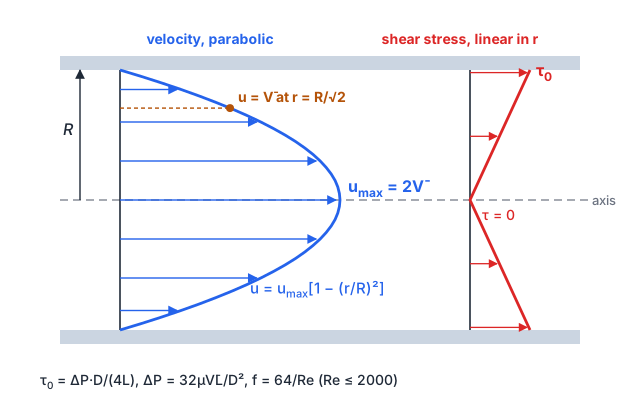
Where the local velocity equals the mean: at $r = R/\sqrt2 \approx 0.707R$ in a pipe.
Trap: some books take the critical Reynolds number as 2300, not 2000. Use the value the question gives; for parallel plates, $Re$ uses the mean velocity and the gap or hydraulic diameter as the question defines it.
Pumping power for laminar pipe flow: $P = Q\,\Delta P = \dfrac{128\mu L Q^2}{\pi D^4}$.
CH 11Turbulent flow
- Shear stress: $\tau = \mu\dfrac{d\bar u}{dy} - \rho\overline{u'v'}$ (laminar + Reynolds stress).
- Prandtl mixing length: $\tau_t = \rho l^2\left(\dfrac{d\bar u}{dy}\right)^2$, $l = \kappa y$, $\kappa \approx 0.4$.
- Friction velocity: $u_* = \sqrt{\tau_0/\rho}$; laminar sublayer $\delta' = 11.6\,\nu/u_*$.
- Smooth or rough (roughness $k_s$): smooth if $k_s/\delta' < 0.25$, then $f = f(Re)$; rough if $k_s/\delta' > 6$, then $f = f(k_s/D)$ only; in between, both.
- 1/7th power law: $\dfrac{u}{u_{max}} = \left(\dfrac yR\right)^{1/7}$, $\bar V \approx 0.817\,u_{max}$, $\alpha \approx 1.06$, $\beta \approx 1.02$.
- Blasius (smooth pipe): $f = 0.316\,Re^{-1/4}$ for $Re < 10^5$.
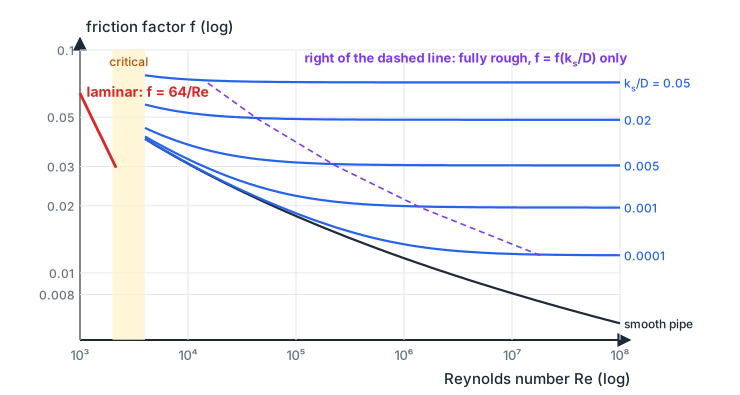
Trap: "smooth" and "rough" depend on the flow. Raise the velocity, $u_*$ rises, the sublayer thins and the same pipe turns rough.
Moody chart: in the fully rough zone $f$ depends only on $k_s/D$, so raising the velocity no longer changes $f$.
CH 12Boundary layer and separation
- Displacement thickness: $\delta^* = \displaystyle\int_0^\delta\left(1 - \frac{u}{U}\right)dy$. Momentum thickness: $\theta = \displaystyle\int_0^\delta\frac uU\left(1 - \frac uU\right)dy$. Energy thickness: $\delta^{**} = \displaystyle\int_0^\delta\frac uU\left(1 - \frac{u^2}{U^2}\right)dy$.
- Shape factor $H = \delta^*/\theta$: 2.59 laminar (Blasius), 1.3–1.4 turbulent.
- Von Kármán momentum integral: $\dfrac{\tau_0}{\rho U^2} = \dfrac{d\theta}{dx}$. Valid when: zero pressure gradient ($dP/dx = 0$, $U$ constant), as on a flat plate Fallback · Momentum-integral method for a given profile: find $\theta$ from the profile → $\tau_0 = \mu\left(\dfrac{\partial u}{\partial y}\right)_{y=0}$ → set $\tau_0 = \rho U^2\dfrac{d\theta}{dx}$ → separate and integrate from $\delta = 0$ at $x = 0$ to get $\delta/x$, then $C_{fx}$
| Laminar (Blasius) | Turbulent (1/7th power) | |
|---|---|---|
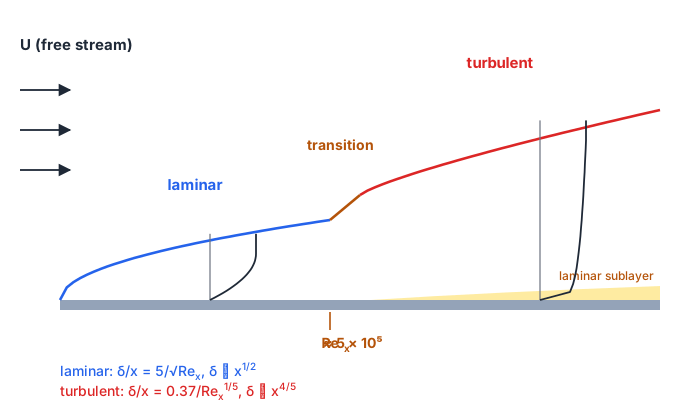
| Thickness | $\dfrac\delta x = \dfrac{5.0}{\sqrt{Re_x}}$, $\delta \propto x^{1/2}$ | $\dfrac\delta x = \dfrac{0.37}{Re_x^{1/5}}$, $\delta \propto x^{4/5}$ |
| Local skin friction | $C_{fx} = \dfrac{0.664}{\sqrt{Re_x}}$, $\tau_0 \propto x^{-1/2}$ | $C_{fx} = \dfrac{0.059}{Re_x^{1/5}}$, $\tau_0 \propto x^{-1/5}$ |
| Average drag coefficient | $C_D = \dfrac{1.328}{\sqrt{Re_L}}$ (twice $C_{fx}$ at $L$) | $C_D = \dfrac{0.074}{Re_L^{1/5}}$ ($\tfrac54 C_{fx}$ at $L$) |
| $\delta^*$, $\theta$ | Blasius $\delta^* = 0.344\delta$; parabolic profile $\delta^* = \delta/3$, $\theta = 2\delta/15$; cubic profile $\delta^* = 3\delta/8$, $\theta = 39\delta/280$ | $\delta^* = \delta/8$, $\theta = 7\delta/72$ |
- Separation needs an adverse pressure gradient, $dP/dx > 0$; with $dP/dx < 0$ it cannot happen. At the wall: $(\partial u/\partial y)_{y=0} > 0$ attached, $= 0$ separation point, $< 0$ reversed flow.
- Transition on a flat plate at about $Re_x = 5\times10^5$.
- Drag on a body: $F_D = C_D\,\tfrac12\rho V^2 A$ ($A$ = frontal area); power to overcome it $P = F_D V$. Stokes' law, creeping flow past a sphere ($Re = \rho V d/\mu < 1$): $F_D = 3\pi\mu V d$, so $C_D = 24/Re$. Terminal velocity when weight = buoyancy + drag: $V_t = \dfrac{(\rho_s - \rho_f)\,g\,d^2}{18\mu}$. Fallback · Force balance: weight = buoyancy + drag: $\dfrac{\pi d^3}{6}\rho_s g = \dfrac{\pi d^3}{6}\rho_f g + 3\pi\mu V_t d$ → $V_t = \dfrac{(\rho_s - \rho_f)g d^2}{18\mu}$
Why golf balls have dimples: a turbulent layer carries more momentum near the wall, resists the adverse gradient longer and separates later, so the wake and the pressure drag shrink.
Trap: a long plate is laminar up to $Re_x = 5\times10^5$ and turbulent beyond: a mixed layer, unless the question says to treat it as one type.
Scaling: laminar $\delta \propto \sqrt{x}$, $\tau_0 \propto 1/\sqrt{x}$; laminar drag on a plate $\propto U^{3/2}\sqrt{L}$.
CH 13Dimensional analysis and models
- Buckingham π: number of π terms $= n - m$ ($n$ variables, $m$ fundamental dimensions, usually 3: M, L, T). Repeating variables must not form a dimensionless group among themselves.
| Number | Formula | Ratio | Governs |
|---|---|---|---|
| Reynolds | $\rho VL/\mu$ | Inertia / viscous | Pipe flow, submarines, aircraft at low speed |
| Froude | $V/\sqrt{gL}$ | $\sqrt{\text{inertia/gravity}}$ | Spillways, open channels, ships |
| Euler | $\Delta P/(\rho V^2)$ | Pressure / inertia | Cavitation, pressure-driven flow |
| Weber | $\rho V^2 L/\sigma$ | Inertia / surface tension | Droplets, sprays, capillary waves |
| Mach | $V/c = V/\sqrt{\gamma RT}$ | $\sqrt{\text{inertia/elastic}}$ | Compressible flow, $Ma > 0.3$ |
- Froude similarity (scale $L_r$, $g_r = 1$): $V_r = L_r^{1/2}$, $T_r = L_r^{1/2}$, $Q_r = L_r^{5/2}$, $F_r = \rho_r L_r^3$, $P_r = \rho_r L_r^{7/2}$.
- Reynolds similarity: $V_r = \nu_r/L_r$, $Q_r = \nu_r L_r$.
Distorted models (rivers, harbours): a larger horizontal than vertical scale keeps depths measurable, the flow turbulent and surface tension negligible.
Repeating variables: choose one geometric ($D$), one kinematic ($V$) and one dynamic ($\rho$); never the dependent variable.
Froude timing: a model event taking $t_m$ takes $t_p = t_m\sqrt{L_r}$ in the prototype; a 1:25 spillway model running 1 min corresponds to 5 min.
CH 14Compressible flow basics GATE ME syllabus
- Speed of sound: $c = \sqrt{K/\rho} = \sqrt{\gamma RT}$ (air at 15 °C: about 340 m/s). Mach number $Ma = V/c$; Mach angle $\sin\mu = 1/Ma$. Incompressible treatment is fine below $Ma \approx 0.3$.
- Stagnation (isentropic) relations: $\dfrac{T_0}{T} = 1 + \dfrac{\gamma - 1}{2}Ma^2$, $\dfrac{P_0}{P} = \left(\dfrac{T_0}{T}\right)^{\gamma/(\gamma-1)}$, $\dfrac{\rho_0}{\rho} = \left(\dfrac{T_0}{T}\right)^{1/(\gamma-1)}$.
- Area–velocity: $\dfrac{dA}{A} = (Ma^2 - 1)\dfrac{dV}{V}$: subsonic flow speeds up (and $P$ falls) in a converging duct, supersonic flow speeds up in a diverging one; $Ma = 1$ can occur only at the throat.
- Critical ratios (air, $\gamma = 1.4$, at $Ma = 1$): $T^*/T_0 = 0.833$, $P^*/P_0 = 0.528$, $\rho^*/\rho_0 = 0.634$.
- Normal shock: upstream supersonic, downstream subsonic. $Ma$ and $V$ fall (supersonic to subsonic); $P$, $T$, $\rho$ and entropy rise; $T_0$ is unchanged; $P_0$ falls, so $A^*$ grows: $A_2^*/A_1^* = P_{01}/P_{02}$.
- Energy (adiabatic): $h_0 = h + \dfrac{V^2}{2}$, so $V = \sqrt{2c_p(T_0 - T)}$; $T_0$ stays constant along any adiabatic duct, with or without friction or shocks.
- Area–Mach relation: $\dfrac{A}{A^*} = \dfrac{1}{Ma}\left[\dfrac{2}{\gamma+1}\left(1 + \dfrac{\gamma-1}{2}Ma^2\right)\right]^{\frac{\gamma+1}{2(\gamma-1)}}$. Each $A/A^* > 1$ has two answers, one subsonic and one supersonic (air: $A/A^* = 1.688$ at $Ma = 2$).
- Choked mass flow: $\dot m_{max} = A^* P_0\sqrt{\dfrac{\gamma}{RT_0}}\left(\dfrac{2}{\gamma+1}\right)^{\frac{\gamma+1}{2(\gamma-1)}}$; for air, $\dot m_{max} = 0.0404\,\dfrac{A^* P_0}{\sqrt{T_0}}$ (SI). It depends on $P_0$ and $T_0$ only, not on the back pressure. Fallback · Sonic throat: $\dot m = \rho^* A^* c^*$ with $\rho^* = \dfrac{P_0}{RT_0}\left(\dfrac{2}{\gamma+1}\right)^{\frac{1}{\gamma-1}}$ and $c^* = \sqrt{\gamma R T_0\cdot\dfrac{2}{\gamma+1}}$; multiply, and the exponents add: $\dfrac{1}{\gamma-1} + \dfrac12 = \dfrac{\gamma+1}{2(\gamma-1)}$
- Normal-shock relations (1 upstream, 2 downstream): $Ma_2^2 = \dfrac{Ma_1^2 + \frac{2}{\gamma-1}}{\frac{2\gamma}{\gamma-1}Ma_1^2 - 1}$; $\dfrac{P_2}{P_1} = 1 + \dfrac{2\gamma}{\gamma+1}(Ma_1^2 - 1)$; $\dfrac{\rho_2}{\rho_1} = \dfrac{V_1}{V_2} = \dfrac{(\gamma+1)Ma_1^2}{(\gamma-1)Ma_1^2 + 2}$; $\dfrac{T_2}{T_1} = \dfrac{P_2/P_1}{\rho_2/\rho_1}$. Prandtl: $V_1V_2 = c^{*2}$.
- Isothermal flow in a uniform pipe: $\rho V$ is constant, so as the pressure (and density) falls along the pipe the velocity rises.
| Normal shock, air | $Ma_2$ | $P_2/P_1$ | $\rho_2/\rho_1$ | $T_2/T_1$ | $P_{02}/P_{01}$ |
|---|---|---|---|---|---|
| $Ma_1 = 1$ | 1 | 1 | 1 | 1 | 1 |
| $Ma_1 = 2$ | 0.577 | 4.5 | 2.667 | 1.687 | 0.721 |
| $Ma_1 \to \infty$ | 0.378 | $\to\infty$ | 6 (limit) | $\to\infty$ | $\to 0$ |
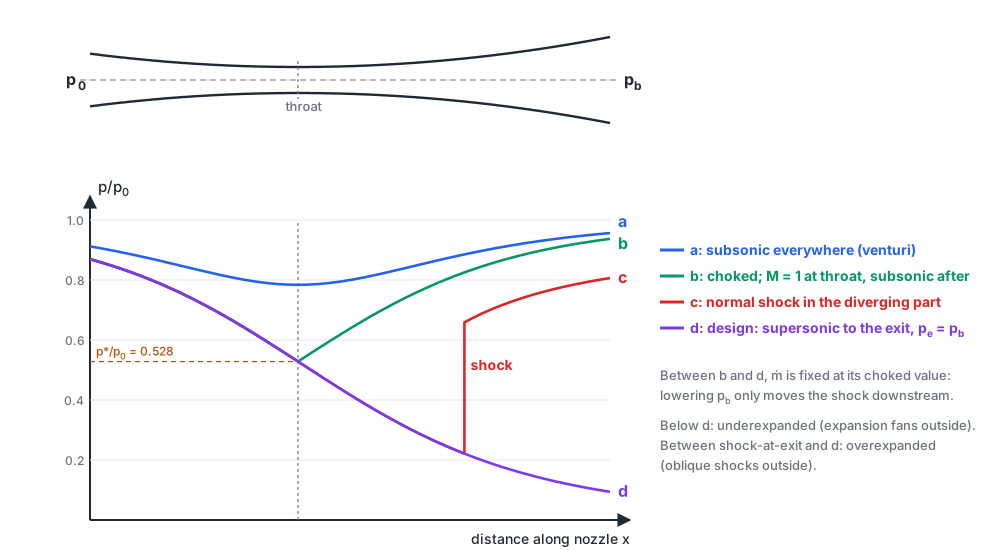
| Converging nozzle | Exit | Mass flow |
|---|---|---|
| $P_b/P_0 > 0.528$ | Subsonic, $P_e = P_b$ | Rises as $P_b$ falls |
| $P_b/P_0 \le 0.528$ (choked) | $Ma_e = 1$, $P_e = 0.528P_0$ | Fixed at $\dot m_{max}$; expansion continues outside |
Trap: stagnation temperature is constant across a shock; stagnation pressure is not.
Trap: once the throat is choked, lowering the back pressure does not increase the mass flow. But raising the inlet $P_0$ does, in proportion ($\dot m \propto P_0/\sqrt{T_0}$), while the exit Mach number stays 1.
Trap: a pressure rise along a supersonic diverging channel can only come from a normal shock: an isentropic supersonic flow keeps accelerating there, and its pressure falls.
Supersonic diverging duct: velocity up, pressure, temperature and density down, the opposite of subsonic flow (2023: $A_2 = 2A_1$ with $u_1 = 400$ m/s, which is supersonic, gives $u_2 > u_1$ and $P_2 < P_1$).
CH 15Open-channel flow GATE CE · ESE
- Chézy and Manning: $V = C\sqrt{RS}$; $V = \dfrac1n R^{2/3}S^{1/2}$, hydraulic radius $R = A/P$.
- Most economical sections: rectangle $b = 2y$, $R = y/2$; trapezoid: half a hexagon, $R = y/2$; triangle: $90°$ apex.
- Specific energy: $E = y + \dfrac{V^2}{2g}$. Rectangular: critical depth $y_c = \left(\dfrac{q^2}{g}\right)^{1/3}$, $E_{min} = \tfrac32 y_c$, $Fr = 1$.
- Hydraulic jump (rectangular): $\dfrac{y_2}{y_1} = \dfrac12\left(\sqrt{1 + 8Fr_1^2} - 1\right)$; energy lost $\Delta E = \dfrac{(y_2 - y_1)^3}{4y_1y_2}$.
Froude number tells the regime: $Fr < 1$ subcritical (deep, slow), $Fr > 1$ supercritical (shallow, fast). A hydraulic jump forms only from supercritical to subcritical.